
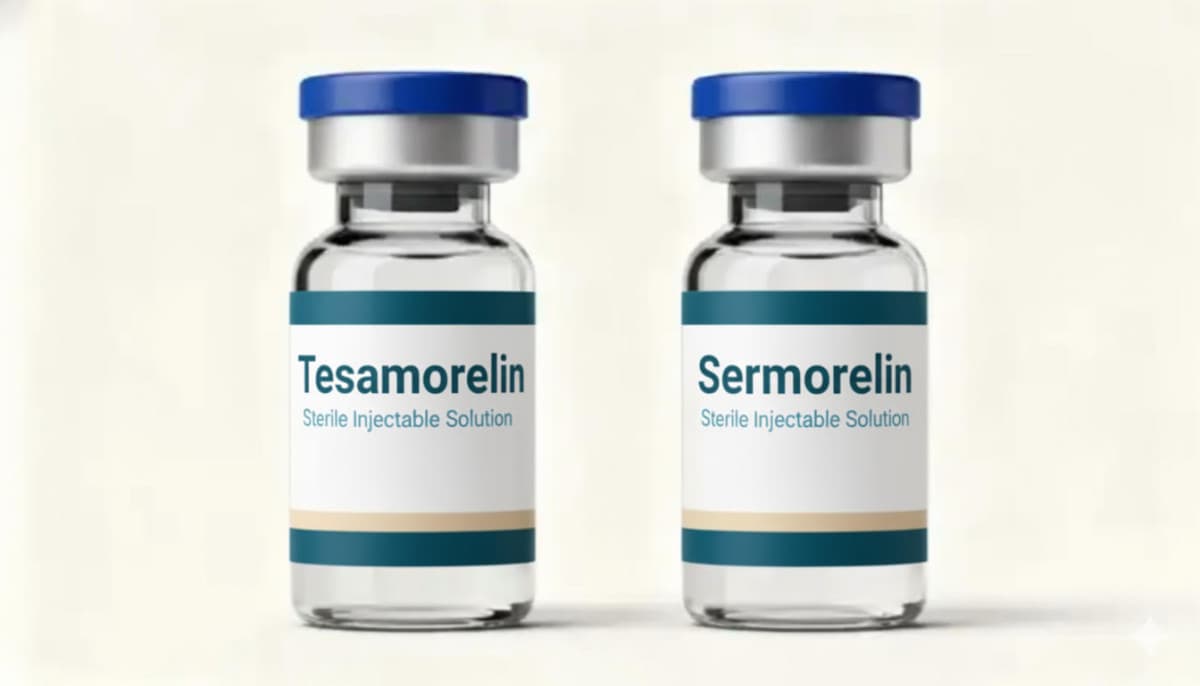
Tesamorelin and Sermorelin represent two distinct synthetic variants of growth hormone-releasing hormone (GHRH) that offer researchers different experimental pathways despite sharing the common mechanism of interacting with pituitary receptors to promote growth hormone release. The fundamental differences between these peptides lie in their structural characteristics, pharmacological profiles, and subsequent biological effects that directly influence their application in scientific research settings.
Tesamorelin consists of 44 amino acids configured as a stabilized analog specifically designed to enhance receptor affinity and extend its half-life. This structural design enables sustained engagement with receptors, resulting in prolonged downstream activity of growth hormone and IGF-1. In experimental models, this pharmacological profile has been linked to targeted lipolytic effects in visceral adipose tissue and observable alterations in metabolic signaling markers. The sustained stimulation provided by Tesamorelin supports research focused on visceral adipose modulation and prolonged anabolic signaling pathways.
In contrast, Sermorelin presents as a 29-amino-acid fragment corresponding to the endogenous GHRH(1-29) structure. This peptide promotes growth hormone release from the pituitary in a pulsatile manner that closely resembles natural secretion patterns. The resulting physiological rhythm leads to intermittent spikes in GH and IGF-1 levels, which may affect recovery processes, metabolic signaling, and anabolic pathways in research models where rhythmic stimulation proves pertinent. Sermorelin's pulsatile pattern makes it advantageous for studies investigating physiological GH dynamics, endocrine rhythms, and tissue recovery mechanisms.
Both peptides require careful handling and storage considerations to maintain stability and research integrity. Lyophilized peptides should be stored at low temperatures ranging from -20°C to -80°C, protected from moisture and light exposure. Reconstituted peptides demand immediate preparation under sterile conditions with proper aliquoting to minimize freeze-thaw cycles. Researchers must select appropriate solvents that ensure solubility, including sterile water, bacteriostatic water, or minimal amounts of DMSO for hydrophobic sequences. Proper documentation including peptide name, concentration, solvent type, and preparation date ensures experimental reproducibility.
The selection between Tesamorelin and Sermorelin fundamentally depends on experimental objectives. Tesamorelin offers prolonged receptor occupancy and consistent downstream signaling suitable for studies requiring sustained GH and IGF-1 elevations or examinations of visceral adipose tissue effects. Sermorelin preserves natural secretion patterns that support research into temporal dynamics of GH-dependent pathways and endocrine feedback mechanisms. Future research directions may include combination studies with other growth hormone secretagogues or metabolic modulators to reveal potential synergistic signaling effects. Additional information about peptide research applications can be found at https://lotilabs.com.